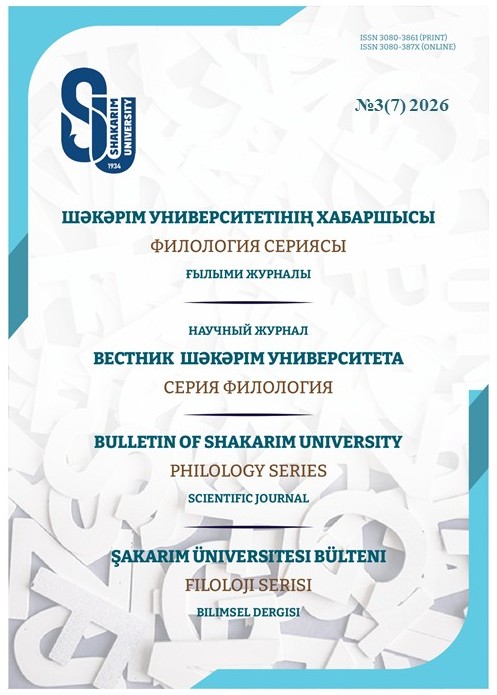
THE EXPERIENCE OF LEXICOGRAPHIC DESCRIPTION OF THE LANGUAGE OF SHAKARIM’S WORKS IN A DICTIONARY ENTRY
DOI:
https://doi.org/10.53360/3080-3861-2026-3(7)-1Keywords:
dictionary, lexicography, text, context, semantics, register, ideographyAbstract
The article systematically examines the scientific and lexicographic principles underlying the compilation of the forthcoming Dictionary of Shakarim. The object of the study is the composition of lexical units in the poet’s works, their semantic features, functions in the literary text, and the ways in which they are presented in the form of dictionary entries. The paper provides a comprehensive analysis of the content organization of the dictionary, the procedure for selecting and systematizing material, methods of presenting linguistic data, and principles of interpreting word meanings.
The aim of the study is to describe the structure of a dictionary entry and to identify the semantic features of the words used by Shakarim on the basis of literary context. In accordance with this aim, the study applies methods of selecting linguistic material from Shakarim’s works, classifying lexical units into semantic groups, structural description, contextual analysis, and the comparative-descriptive method.
The article defines the procedure for compiling a dictionary entry, its main structural components, criteria for distinguishing meanings, ways of presenting illustrative examples, and the specific features of reflecting the author’s usage. Taking into account the main lexicographic and semantic features of poetic words, the study aims to develop a scientific model of an authorial dictionary that characterizes the language of Shakarim. The scientific significance of the research lies in its contribution to a deeper understanding of the linguistic nature of Shakarim’s works, the systematic description of the poet’s individual word usage, and the study of the historical development of the Kazakh literary language from a lexicographic perspective.
Downloads
Published
Issue
Section
License

This work is licensed under a Creative Commons Attribution-NonCommercial 4.0 International License.
Copyright presupposes the integrity and responsibility of each co-author who made a significant contribution to the writing of the article.
The author has the right to store his publications in an institutional or other repository of his choice, provided he provides the appropriate link to the journal’s website.